9-1 DRAWING OF SHEET METAL
Drawing is a technological process during which a flat piece of sheet-metal material (i.e., blank) is transformed into a hollow, three-dimensional object. Such transformation can be produced either in a single step, or in a sequence of operations, each of them changing the shape but partially.
During the process of drawing, the material is forced to follow the movement of a punch, which pulls it along, on its way through the die. There the shape of the part and sometimes even the thickness of it are altered.
At first, the drawn material has to overcome its own elastic limit, succumbing to plastic deformation right afterwards. Various forces are acting upon the drawn cup (as shown in Fig. 9-1), be it the blankholder's pressure, or the friction between the drawn shell and other components of tooling. The blank is sometimes restricted from unreservedly following the punch, by having its edges confined between the surface of the die and those of a blankholder.
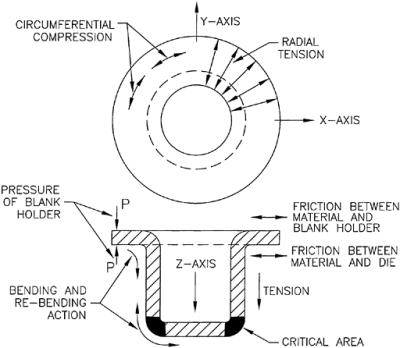 Figure 9-1: Forces involved in cup-drawing process.
 The main area of concern on the drawn part is located between the heel of the vertical wall and the bottom of the shell, where, due to the change in flow direction, the vertical tension acting upon the material is transformed into a triple-axial tension. In this section, the material is being bent, while moving around the edge of the drawing punch, only to be straightened right afterwards, so that another successive segment can be bent-and-straightened.


 TABLE OF CONTENTS