Handbook of Die Design, Second Edition

Mechanical properties of materials are assessed through actual testing, with results of these tests recorded for future reference. The most common test is the hardness test, which is performed using several testing methods. The process is described in Sec. 14-2-2, "Hardness of Materials." Additional testing of mechanical properties is as follows.
Static tensile testing is performed by applying a static load to the tested material. The testing process is free from sudden impacts, load cycling, or abrupt changes. The amount of force, if increased, is regulated slowly and gradually.
Static load testing is performed mainly to assess the elongation of the material, and the testing records should include the amount of elongation with reference to the applied force. Marginally, torsion testing and compression testing is performed similarly.
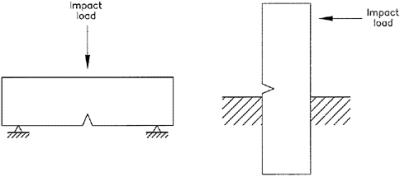
Izod impact testing (or Charpy) is used to ascertain the toughness of a material. A notched bar of steel is attached into the vise and a pendulum type of hammer is allowed to drop onto the tested piece to break it (Fig. 14-8). A ductile material will need a greater amount of energy or more blows to be split than its nonconductive counterpart, even if they are both of the same strength. The ductile material is therefore tougher.
The orientation of applied force with reference to the material grain is important, as every material displays different results along its grain from those against...