Handbook of Die Design, Second Edition

The appropriate tool material must be carefully selected to be in accordance with requirements of the machining and fabricating process and the final product requirements. The most important points to consider are the necessary strength of the tooling and its toughness, hot hardness, thermal shock resistance, and chemical stability.
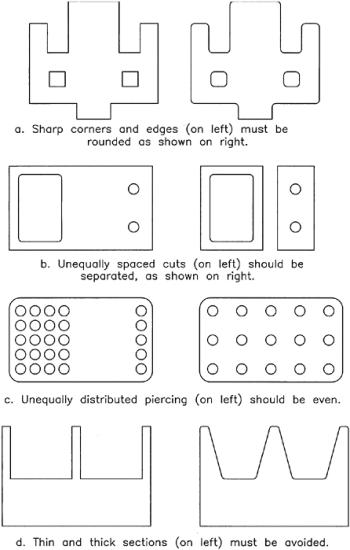
Since all tool steel materials are heat-treated for attainment of best properties, the behavior of steel material during the process of heat treatment is important. Any greater distortion produced by heat treatment should call for attention toward the selection of material, or part design, or manufacturing flawlessness, in this order. Some materials are more prone to distortion caused by heat treatment than others. Less stable steels need more conservative design methods in order to sustain the stress placed upon them by heat treatment. Long thin sections should be avoided or properly supported. Sharp corners, holes placed too close to the edges, or mixing of thin and thick sections should definitely be avoided. Some ideas are presented in Fig. 14-12.
The depth of surface hardening and the material's resistance to decarburization are important aspects of proper tool material selection. Naturally, the machinability of the material is of essence, as a tool made of material which is difficult to machine will cost much more to produce than its counterpart made of easily machinable material.
Wear resistance and hot hardness are other important segments of tooling material...