The Handbook of Hazardous Materials Spills Technology
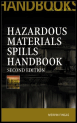
As an all-new update to the classic Hazmat reference book, this text addresses issues such as International law and regulations, risk assessment, biological effects, spill modeling, and more.
 TABLE OF CONTENTS
 Since about 1975, much research has been devoted to consequence modeling. This has involved the modeling, mathematically as well as physically, of the chemical and physical phenomena associated with major industrial hazards (MIH). Such models are used primarily in risk assessments for safety reports and by safety officers. These models may therefore influence very important decisions, such as the design or authorization of chemical plants. Proper attention should therefore be paid to the quality of these models.
The quality of consequence models, especially dense gas dispersion models, started to be assessed around 1980. From that time, experimental data, both at laboratory scale and at field scale, have been gathered. Among the more famous large-scale experiments are those performed by Lawrence Livermore National Laboratory in the United States (with names like Desert Tortoise, Coyote, and Burro) and those by Shell and UK Health and Safety Executive in Europe (Maplin Sands, Thorney Island). These experiments resulted in a considerable improvement of the available models, reducing the range of variation between the predictions of the different models (McQuaid, 1983).
As modeling capabilities increase and more complex problems are addressed, however, there remains a serious concern related to model quality and the possible limits for areas of application. Since the Thorney Island trials, the European Commission (Directorate General XII, EC DGXII) alone has supported two major series of field tests in parallel...