The Handbook of Hazardous Materials Spills Technology
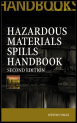
As an all-new update to the classic Hazmat reference book, this text addresses issues such as International law and regulations, risk assessment, biological effects, spill modeling, and more.
 TABLE OF CONTENTS
 In 1979, the Environmental Emergencies Branch embarked on an accelerated program to improve the response and countermeasures technology for spills of materials other than oil. As an essential part of this program, a methodology was devised to develop a priority list of chemicals on which to focus further research efforts. A list was compiled of 150 hazardous materials with significant potential to be spilled in Canada. This list was then used to develop specialized countermeasures, analytical techniques, and spill manuals for these chemicals. Individual manuals called EnviroTIPS were prepared for the first 50 priority substances. Tests of the utility (mathematical efficiency) of the priority list showed that a large portion of the spills were those of the higher priority substances.
Statistical spill data are extremely useful for setting priorities and identifying project needs for spill prevention and preparedness. This was recognized in 1972, and a database was developed to consolidate all Canadian spill data. This database is known as NATES, short for National Analysis of Trends in Emergencies System. The NATES database now contains data on over 150,000 spill events. About 60% of these spill events are related to oil and petroleum products. About 20%...