Handbook of Mechanical Engineering Calculations, Second Edition
Section 23: Spring Selection and Analysis

PROPORTIONING HELICAL SPRINGS BY MINIMUM WEIGHT

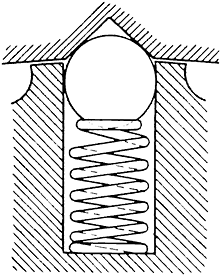
The detent helical spring in Fig. 1 is to be designed so that force P 1 for the extended condition is to be 20 lb (88.9 N). After an additional compression of 0.625 in (1.59 cm) the shearing stress in the spring is to be 75,000 lb/in 2 (517 MPa). The spring index, c, is approximately 8, based on past experience, and the modulus of elasticity in shear is 11,500,000 lb/in 2 (79.2 GPa). Find the diameter of the wire, helix radius, and number of active coils for the smallest amount of material in the spring.


Figure 1: Spring-loaded detent, ( Product Engineering.)

Calculation Procedure:

1. Find the diameter of the spring wire

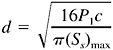
A spring which will contain the smallest possible amount of material will have design parameters selected so that the maximum force, stress, and deflection are exactly twice the minimum force, stress, and deflection, respectively. With such parameters, the spring wire diameter,


where d = spring wire diameter, in (cm); P 1 = force in the extended condition, lb (N); c = spring index, dimensionless; ? = 3.1416; ( S s) max = shear stress in the spring wire, lb/in 2 (kPa). Substituting, d = (16 20 8775,000 ?) 0.5 = 0.1042 in (0.265 cm). Referring to a spring wire table, choose No. 12 wire with d = 0.1055 in (0.268 cm) as the nearest commercially available...

UNLIMITED FREE
ACCESS
TO THE WORLD'S BEST IDEAS

SUBMIT
Already a GlobalSpec user? Log in.

This is embarrasing...

An error occurred while processing the form. Please try again in a few minutes.

Customize Your GlobalSpec Experience

Category: Compression Springs
Finish!
Privacy Policy

This is embarrasing...

An error occurred while processing the form. Please try again in a few minutes.