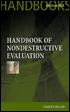
Handbook of Nondestructive Evaluation

Chapter 4: Penetrant Testing

I. INTRODUCTION

Penetrant testing (PT) is one of the most widely used nondestructive testing methods for the detection of surface discontinuities in nonporous solid materials. It is almost certainly the most commonly used surface NDT method today because it can be applied to virtually any magnetic or nonmagnetic material. PT provides industry with a wide range of sensitivities and techniques that make it especially adaptable to a broad range of sizes and shapes. It is extremely useful for examinations that are conducted in remote field locations, since it is extremely portable. The method is also very appropriate in a production-type environment where many smaller parts can be processed in a relatively short period of time. This method has numerous advantages and limitations that can be found in Section X of this chapter.

II. HISTORY AND DEVELOPMENT

Although the exact date of the first penetrant test is unknown, it is generally believed that the earliest tests were performed in the late 19th century and were primarily limited to the examination of various railroad parts, such as axles and shafts. Even though it was a very rudimentary method, it was capable of revealing fairly large cracks in metallic parts by using what is referred to as the oil and whiting method. It is interesting to note that the oil and whiting method employed the same processing steps that are in use today with current penetrant testing procedures. In this early penetrant method, the part to be examined was cleaned and then submerged...

UNLIMITED FREE
ACCESS
TO THE WORLD'S BEST IDEAS

SUBMIT
Already a GlobalSpec user? Log in.

This is embarrasing...

An error occurred while processing the form. Please try again in a few minutes.

Customize Your GlobalSpec Experience

Category: Nondestructive Testing (NDT) Supplies and Accessories
Finish!
Privacy Policy

This is embarrasing...

An error occurred while processing the form. Please try again in a few minutes.