Handbook of Nondestructive Evaluation

Chapter 6: Radiographic Testing

I. HISTORY AND DEVELOPMENT

The history of radiographic testing (RT) actually involves two beginnings. The first commenced with the discovery of x-rays by Wilhelm Conrad Roentgen in 1895 and the second with the announcement by Marie and Pierre Curie, in December of 1898, that they had demonstrated the existence of a new radioactive material called radium.

The Discovery of x-Rays

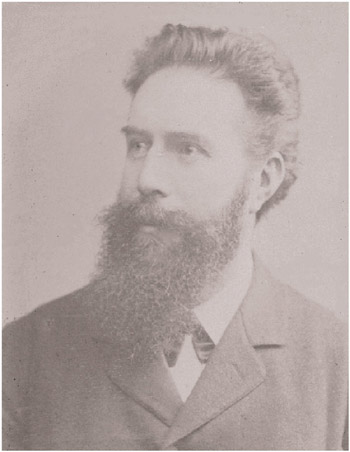
One of the true giants in radiography is the man who discovered x-rays Wilhelm Conrad Roentgen (Figure 6-1). Roentgen was born on March 27, 1845 in Lennep, Germany. His birth house is still in existence and is presently a magnificent museum containing many of the artifacts that he used in his early days of experimenting. It also includes many radiographic devices and interesting radiographs that had been taken over the years as a result of his discovery.


FIGURE 6-1: Wilhelm Conrad Roentgen. (Courtesy Charles J. Hellier.)

Roentgen was educated in Utrecht and Zurich and ultimately became a Professor of physics at Strasbourg in 1876, Giessen in 1879, and Wurzburg in 1888, where his famous discovery took place. He later became a Professor of physics in Munich in 1899.

There are various accounts as to how x-rays were actually discovered during those days in his experimental laboratory at the University of Wurzburg (Figure 6-2). Most accounts agree that the discovery took place on November 8, 1895, while he was working in his laboratory. He apparently had been working in a semidarkened laboratory room and was experimenting with a vacuum tube, referred to...

UNLIMITED FREE
ACCESS
TO THE WORLD'S BEST IDEAS

SUBMIT
Already a GlobalSpec user? Log in.

This is embarrasing...

An error occurred while processing the form. Please try again in a few minutes.

Customize Your GlobalSpec Experience

Category: X-ray Instruments and X-ray Systems
Finish!
Privacy Policy

This is embarrasing...

An error occurred while processing the form. Please try again in a few minutes.