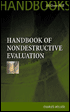
Handbook of Nondestructive Evaluation

The use of sound energy to determine the integrity of solid objects is probably as old as mankind s ability to manufacture objects in pottery and metal. The English language has many words and phrases that illustrate the acceptance of this fact and hint at the way in which sound was used in the past to test for integrity. Expressions such as the ring of truth or sound as a bell are commonplace in everyday speech to indicate quality, honesty, or good health.
Both phrases allude to the fact that a sharp tap on a solid object will set up a vibration at the natural frequency of the object; that is how a bell or any percussion instrument makes music. Any major disruption of the homogeneity of the object will distort that natural frequency and indicate that there is a problem. The instinct to tap an object is so ingrained into human nature that it probably accounts for all those people who, when viewing a prospective second-hand car purchase, unconsciously kick a tire!
The problem with this simple approach to testing an object is that it takes a relatively large imperfection to cause a significant change in sound for the human ear to detect. This is because the determining factor is the wavelength of the sound wave encountering an imperfection in relation to the size of the imperfection. Wavelength, in turn, depends on the speed of sound in the object and the frequency, or pitch, of the sound wave.