Hydrodynamics of High-Speed Marine Vehicles

Containing many illustrations, examples and exercises, this book covers all aspects of marine hydrodynamics and all types of high-speed marine vehicles.
 TABLE OF CONTENTS
 A main resistance component is caused by the friction force on the wetted hull. Pressure loads acting perpendicularly to the hull surface matter, but have less importance. Boundary layer theory may be used to describe the effect of fluid viscosity. It means that the viscosity only matters in a thin layer close to the hull surface. The two-dimensional boundary layer along a flat plate can be used to describe important characteristics of the viscous flow. We can approximate the wetted hull surface as a flat plate. If we look at the flow from a reference frame following the ship, the forward speed of the ship appears as an incident flow with velocity U on a stationary hull, as shown in Figure 2.3.
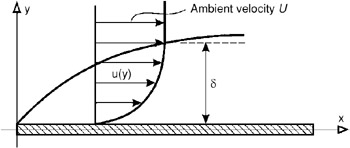
One important characteristic is that the water must adhere to the plate, that is, there is no slip. That means the flow velocity is zero on the plate. At a short perpendicular distance ?( x) from the plate (function of the longitudinal distance x from the leading edge of the plate), the flow velocity is equal to U.
The viscous flow is laminar for Reynolds number Rn x = Ux/ ? less than ? 10 5. Here ? is the kinematic viscosity coefficient with 1 .35 10 ?