Hydrodynamics of High-Speed Marine Vehicles

Containing many illustrations, examples and exercises, this book covers all aspects of marine hydrodynamics and all types of high-speed marine vehicles.
 TABLE OF CONTENTS
 Model testing is the standard procedure to predict the resistance of a ship. A model that is geometrically similar to the ship is manufactured. However, it is normally not equipped with appendages such as a rudder and propulsion system. The reason is scaling problems. The scaling of resistance from model scale to full scale is by means of nondimensional resistance coefficients and knowledge about what flow parameters (Reynolds and Froude numbers) matter. Let us illustrate what we mean by nondimensional resistance using eq. (2.3). We can write
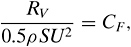
which is a nondimensional quantity. Let us see the consequence of requiring that
| (2.105) | 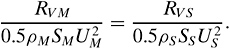 |
Here the subscripts M and S refer to model and full-scale ships, respectively. Let us assume that the hull surface is smooth and the flow at the hull surface is turbulent in both the model and full scales. We will use eq. (2.4), which states that if eq. (2.105) is true, then
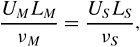
that is, we must have the same Reynolds number in model and full scales. Let us say that L S = 100 m , L M = 5 m, U S = 20 ms ? 1, and the kinematic viscosity coefficient ? M = ? S . This leads to U M = 400 ms ? 1 . It is not difficult to understand that this is not the right procedure. It is impossible in practice to have...