Hydrodynamics of High-Speed Marine Vehicles

Containing many illustrations, examples and exercises, this book covers all aspects of marine hydrodynamics and all types of high-speed marine vehicles.
 TABLE OF CONTENTS
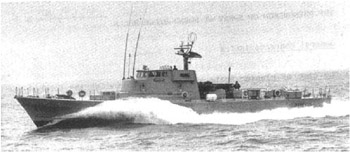
 When the Froude number is larger than approximately 0.5, the occurrence of spray increases strongly with speed. Figure 2.22 shows an example of large spray formation due to a round-bilge hull. M ller-Graf (1991) divides the spray resistance R s into two components, that is,
| (2.100) |  |
where the spray pressure resistance R SP is a function of the Froude number and the spray frictional resistance R SF is a function of the Reynolds number Rn and the Weber number
| (2.101) | 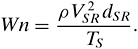 |
Here V SR is the spray velocity, d SR is the spray thickness, and T S is the surface tension at the water-air interface. A representative value of T S is 0.073 Nm ? 1.
M ller-Graf (private communication, 2004) gives the following explanation of R SP: Due to the high stagnation pressure and large pressure gradients at the hull of the forebody near below the free surface, the spray root, a sheet of green water breaks violently out of the water surface, causing hereby a fully turbulent flow in the spray root. The rear part part of the spray root climbs the hull sides up and aft. Because of the development of Helmholtz-Taylor instabilities at the surface of the spray root (Birkhoff and Zarantonello 1957), which are initiated by the turbulence condition, the outward thrown part of the spray root bursts...