Hydrodynamics of High-Speed Marine Vehicles

Containing many illustrations, examples and exercises, this book covers all aspects of marine hydrodynamics and all types of high-speed marine vehicles.
 TABLE OF CONTENTS
 Hydrodynamics of ship propellers is a speciality by itself and there are textbooks and lecture notes dealing comprehensively with the topic (e.g., Breslin and Andersen 1994, Carlton 1994, Kerwin 1991). Our presentation is of an introductory nature. We first discuss open-water propeller characteristics, meaning how the propeller performs when the ship does not influence the propeller flow. This is the converse of what we assumed to analyze resistance. In that case, we assumed the propeller was not present. Finally, we discuss how to correct for hull-propeller interaction.
Figure 2.34 shows a typical propeller drawing and definitions of commonly used parameters. Most propellers are fixed-pitch propellers. However, some have adjustable blades and are called controllable-pitch propellers. If the propeller viewed from aft of the propeller turns clockwise, it is called right-handed. A left-handed propeller rotates counterclockwise. If a ship is equipped with two propellers (see Figure 2.2), the starboard and port propellers are normally right-handed and left-handed, respectively. The face of the propeller is the propeller surface seen from aft of the propeller. The other side is called the back.
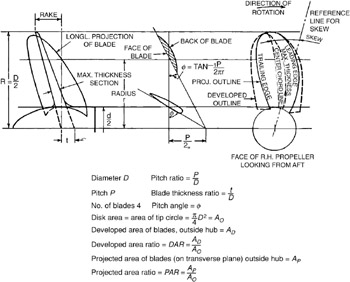
Different areas are used to characterize the propeller. The propeller disc area A 0 is equal to ? D 2 /4, where D is the propeller diameter. The expanded area A E of the propeller is obtained by considering different circular cylinders with axis coinciding with the propeller shaft...