Implementing Value-Added Telecom Services
4.1: Pull and Push Content

4.1 Pull and Push Content

Content delivery involves three agents: the client, the server, and the network. The client is the hardware and software that receives the content, as well as by rendering it. The server is the hardware and software that retrieves and delivers the content in whatever form to the client. The network transports requests for content from client to server, and transports the content itself from server to client.

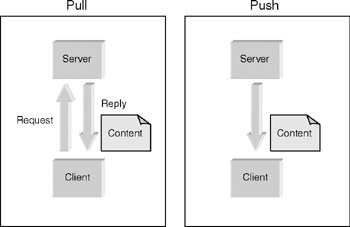
There are many ways to bring content to the consumer, but they are usually broken down in two categories (see Figure 4.1):

  1. Pull: The client makes a request for content to the server and the server responds with the requested content. Navigation on the WWW is a typical example of pull content.

  2. Push: The server spontaneously sends content to the client without a previous request being made. Radio and television broadcasts are typical examples of push content. Some instances of push content (for example, newsletters or pay television) require the client to subscribe previously, but the content itself is sent without explicit requests.


Figure 4.1: Pull and push model for content delivery.

In this chapter we investigate both models of content delivery over networks, with special focus on two questions: What technology is required to deliver content? How can one charge the consumer for it?

UNLIMITED FREE
ACCESS
TO THE WORLD'S BEST IDEAS

SUBMIT
Already a GlobalSpec user? Log in.

This is embarrasing...

An error occurred while processing the form. Please try again in a few minutes.

Customize Your GlobalSpec Experience

Category: News Sites
Finish!
Privacy Policy

This is embarrasing...

An error occurred while processing the form. Please try again in a few minutes.