Physical phenomena are the basis for all technological systems. To perform a function, certain physical phenomena should be appropriately arranged in space and time. For example, to move the bristles of an electric toothbrush, the battery supplies electric energy to the motor, which then converts it into the rotational movement of the rotor which, in turn, actuates a transmission link, setting the brush head in motion.
To improve an existing function, or to introduce a new one, means to make a transition from a particular system s physical structure and/or physics to another, more effective structure and/or physics. As an example of such a transition, consider the external combustion (steam) engine and the internal combustion engine. In the former, the piston is moved by high-pressure steam produced outside of the engine cylinder. In the latter, the fuel burned inside the cylinder moves the piston. In addition to different physical structures, these engines employ different physical phenomena for generating motion.
This chapter describes a modeling approach used in TRIZ for the analysis and synthesis of physical structures and processes in technological systems.
3.1 Minimal Technological System. Substance-Field Models
Any interaction between a tool and an object is accompanied by the generation, absorption, or transformation of energy. Thus, the object, the tool, and the energy of their interaction are necessary and sufficient to build a model of a minimal technological system performing only one function (Fig. 3.1). An effectively performed function requires the presence of, and interaction among, these three elements.
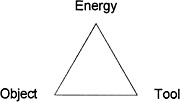 Fig.
Fig.
Copyright V. Fey and E. I. Rivin 2005 under license agreement with Books24x7


 TABLE OF CONTENTS


