Innovation on Demand

5.9: Law of Increasing Controllability

5.9 Law of Increasing Controllability

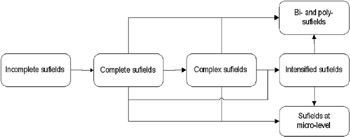
This law is also called the law of increasing substance field interactions. It delineates the evolution of sufields (Fig. 5.33).


Fig. 5.33: Lines of evolution of sufields.

Law of increasing controllability

  • Technological systems evolve towards enhancing their substance field interactions; this involves the following.

    • Incomplete sufields develop into complete sufields, which then evolve into complex sufields.

    • Complete and complex sufields develop into intensified sufields.

5.9.1 Complex sufields

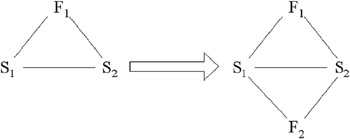
Often, there is a need to maintain an existing sufield (function) and, at the same time, to introduce a new, typically auxiliary function. This is usually achieved by a transition to complex double (Fig. 5.34) or chain (Fig. 5.35) sufields.


Fig. 5.34: Double sufields.

Fig. 5.35: Chain sufields.

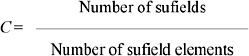
Transition to complex sufields is another mechanism of the increasing degree of ideality. An increase in the number of elements in complex sufields is paid off by increased functionality of these sufields vis- -vis simple ones. The coefficient of convolution, C, (Vertkin, 1984), is the ratio of the number of sufields describing the system, to the number of elements in these sufields (Fig. 5.36).


Fig. 5.36: Coefficient of convolution.

In fact, this coefficient allows one to measure, to a certain degree, the change in the degree of ideality. For a simple sufield, C = 1 /3, for a double sufield, C = 1 /2(2 /4) and for a chain sufield, C = 2 /5.

Example 5.43

Molten metal is poured into...

UNLIMITED FREE
ACCESS
TO THE WORLD'S BEST IDEAS

SUBMIT
Already a GlobalSpec user? Log in.

This is embarrasing...

An error occurred while processing the form. Please try again in a few minutes.

Customize Your GlobalSpec Experience

Category: Water Quality Photometers and Colorimeters
Finish!
Privacy Policy

This is embarrasing...

An error occurred while processing the form. Please try again in a few minutes.