Innovation on Demand

This law establishes the number and functionality of the principal parts of any autonomous technological system.
Law of completeness
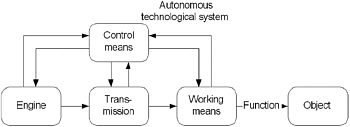
An autonomous technological system consists of four principal parts:
working means, transmission, engine, and control means.
A working means is a component that directly performs the primary function of the system. A transmission transforms the energy produced by the engine (energy source) into the energy that can control the working means. A control means allows for changing the parameters of the other principal parts (Fig. 5.29).
Consider, for example, the technological system photographic camera. The purpose (primary function) of the camera is to transmit the light reflected from an outside body to the film (or to the sensor plate in a digital camera). Therefore, the object to be manipulated by the camera is the light, the working means is the set of lenses, the focus-adjusting mechanism is the transmission, the electric motor is the engine, and the control in many modern cameras is performed by a microprocessor.
The milestones in the evolution of the hammer from a stone to the sledged hammer in Fig. 5.25 clearly show the gradual emergence and development of the principal parts of this technological system.
At early stages of development of many technological systems, some of their principal components are substituted by human components . As these systems evolve, the human components are...