Positioning, or finding the user's location, with GPS requires some understanding of the GPS signal structure and how the measurements can be made. Likewise, as the GPS signal is received through a GPS receiver, understanding the capabilities and limitations of the various types of GPS receivers is essential. Furthermore, the GPS measurements, like all measurable quantities, contain errors and biases, which can be removed or reduced by combining the various GPS observables. This chapter discusses these issues in detail.
2.1 GPS signal structure
As mentioned in Chapter 1, each GPS satellite transmits a microwave radio signal composed of two carrier frequencies (or sine waves) modulated by two digital codes and a navigation message (see Figure 2.1). The two carrier frequencies are generated at 1,575.42 MHz (referred to as the L1 carrier) and 1,227.60 MHz (referred to as the L2 carrier). The corresponding carrier wavelengths are approximately 19 cm and 24.4 cm, respectively, which result from the relation between the carrier frequency and the speed of light in space [1, 2]. The availability of the two carrier frequencies allows for correcting a major GPS error, known as the ionospheric delay (see Chapter 3 for details). All of the GPS satellites transmit the same L1 and L2 carrier frequencies. The code modulation, however, is different for each satellite, which significantly minimizes the signal interference.
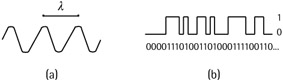 Figure 2.1: (a) A sinusoidal wave; and (b) a digital code.
 The two GPS codes are called coarse acquisition (or C/A-code) and precision (or P-code). Each code consists...
Copyright ARTECH HOUSE, INC. 2002 under license agreement with Books24x7


 TABLE OF CONTENTS