Introduction to GPS: The Global Positioning System

10.10: GPS for seafloor mapping

10.10 GPS for seafloor mapping

Safe and efficient marine navigation requires, among other factors, accurate information about the water depth and the sea bottom [18]. In addition, the availability of accurate water depth is vital for making use of maximum cargo capabilities. This is especially important for areas with shallow water depth. The traditional way of obtaining the water depth was done using a single-beam echo sounder installed on a survey vessel. With this method, the single-beam echo sounder generates a sounding wave (pulse), which is transmitted to the sea bottom and then reflected back to the echo sounder (see Figure 10.10). The water depth is then computed based on the recorded travel time of the sounding pulse and the velocity of the sound in the water [18]. It should be pointed out that the echo sounder uses a hull-mounted device called the transducer to convert the electrical energy into sound energy and vice versa.


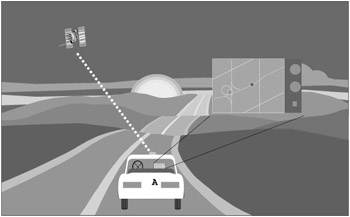
Figure 10.10: GPS for seafloor mapping.

To map an area with a single-beam echo sounder, a survey vessel follows preplanned track lines while the echo sounder generates soundings along the track. Line spacing (the distance between tracks) is selected to provide the best coverage of the area. The accuracy and the reliability of the surveyed depths and locations are verified by supplementing the primary sounding lines by a series of cross lines [18]. This method is characterized by its simplicity. In addition, the echo sounder orientation is not required. A major drawback, however, is that...

UNLIMITED FREE
ACCESS
TO THE WORLD'S BEST IDEAS

SUBMIT
Already a GlobalSpec user? Log in.

This is embarrasing...

An error occurred while processing the form. Please try again in a few minutes.

Customize Your GlobalSpec Experience

Category: Oceanographic Instruments
Finish!
Privacy Policy

This is embarrasing...

An error occurred while processing the form. Please try again in a few minutes.