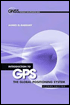
Introduction to GPS: The Global Positioning System, Second Edition
GPS users employ differential techniques to achieve the highest possible positional accuracy. A straightforward manner of doing this is to use two GPS receivers, a base and a rover, as discussed in Chapter 5. However, this may not be cost effective in many instances. An alternative, which could significantly reduce the cost of a survey without degrading the positional accuracy, is to use one of the available GPS data and correction services. If such a service is available within the project area, a GPS user would only need one receiver to be used as a rover; no base receiver is required. A number of various GPS services are currently available with various levels of accuracy and cost. Some services are even provided with no user fees required.
For high-accuracy positioning (e.g., establishing new control points), GPS users may use one of the highly precise permanent GPS reference station networks established by several organizations around the world. These GPS data services are currently available free of charge at the global level, such as the IGS network, as well as at the regional level, such as the Continuously Operating Reference Station (CORS) network in the United States [1 3]. The CACS and the European Reference Frame (EUREF) Permanent Network (EPN) are other regional GPS data services, which are available to users at no cost [4, 5]. The reference stations within these systems operate on a continuous basis and provide access to the modern reference frames, such as the International Terrestrial Reference Frame...