Introduction to GPS: The Global Positioning System, Second Edition
10.9: GPS for Airborne Mapping

10.9 GPS for Airborne Mapping

GPS alone has been successfully used for topographic mapping of small-size areas. Using either conventional GPS kinematic surveying or GPS RTK, a user takes positions of the points on the ground where the topography changes, which can be used at a later time to produce the topographic map of that area. Even in rough areas, GPS can be mounted on all-terrain vehicles to precisely map those areas. However, there exist situations in which the use of GPS alone becomes time-consuming and/or not cost-effective [14]. Examples include mapping large areas, coastal areas, forests, and inaccessible areas.

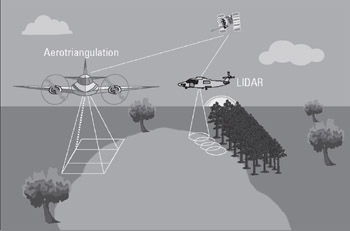
Traditionally, mapping large and inaccessible areas was done using classical airborne photogrammetry. With this method, an aircraft-mounted camera is used to capture a sequence of images for the area to be mapped, which after processing construct the map. To be of practical use, the captured images must first be related to the geodetic reference system (e.g., WGS 84), a process known as georeferencing the images. In classical airborne photogrammetry, the georeferencing is done indirectly with the help of a number of ground control stations with known geodetic coordinates and their corresponding image coordinates. In recent years, GPS has been used onboard the aircraft to provide the precise position of the aerial camera as well as the precise time of each aerial exposure (Figure 10.10) [15].


Figure 10.10: GPS for airborne mapping

The use of GPS in airborne photogrammetry has significantly reduced the required number of ground control points. However, it...

UNLIMITED FREE
ACCESS
TO THE WORLD'S BEST IDEAS

SUBMIT
Already a GlobalSpec user? Log in.

This is embarrasing...

An error occurred while processing the form. Please try again in a few minutes.

Customize Your GlobalSpec Experience

Category: Navigational Instruments
Finish!
Privacy Policy

This is embarrasing...

An error occurred while processing the form. Please try again in a few minutes.