Introduction to GPS: The Global Positioning System, Second Edition
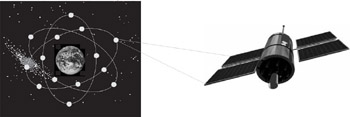
GLONASS is a Russian-developed all-weather satellite-based navigation system that has much in common with GPS. The GLONASS program was initiated in the mid 1970s, with the first satellite launched in October 1982. Similar to GPS, GLONASS is a dual-use system that can be accessed by both military and civilian users. The nominal constellation consists of 21 satellites plus 3 active spares at a nominal altitude of 19,100 km [1]. The satellites are evenly distributed over three orbital planes, each containing 8 satellites (nominally spaced evenly within the orbital plane 45 degrees apart) (see Figure 11.1). A GLONASS satellite orbit is nearly circular, with an orbital period of 11 hours and 15 minutes and an inclination of 64.8 degrees to the equator [2 4].
The GLONASS system consists of three segments: space, control, and user. The space segment consists of the nominal 24-satellite constellation. Similar to GPS, each GLONASS satellite transmits a signal that has a number of components: two L-band carriers C/A-code on L1 (and L2 for the newer generation, GLONASS-M satellites), P-code on both L1 and L2 and a navigation message. However, unlike GPS, each satellite transmits its own carrier frequencies, which depend on the frequency channel number (an integer number assigned to each satellite). During the period 1998 to 2005, GLONASS satellites used the frequency channels 0 to 12. After 2005, the satellites are to use the frequency channels ?7 to 6 [2].