An Introduction to Mixed-Signal IC Test and Measurement

This text encompasses the testing of both analog and mixed-signal circuits, value-added benefits of testing to a manufacturer s product, as well as the role of the test engineer.
 TABLE OF CONTENTS
 Mathematically modeling the behavior of an analog channel using MATLAB or some equivalent software is an important step for understanding the test methods described in this chapter. Through the appropriate software model, we can apply a coherent test signal and analyze the response of the channel using Fourier analysis as if one collected the data directly from a tester.
To begin we must first model the large-signal behavior of an analog channel in the presence of noise. This requires that we divide the analog channel into three components as shown in Figure 8.25. The first block models the presence of noise in the channel, the second block models the nonlinear input-output transfer characteristic, and the third block models the frequency response behavior of the channel.
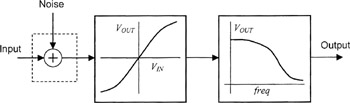
To model the noise of the channel we make use of a normally (Gaussian) distributed random number generator available in MATLAB called randn. This number generator will produce a sequence of independent (uncorrelated) numbers whose statistics are normally distributed with zero mean and unity standard deviation. To create a noise signal with a DC value of V DC and RMS value of V rms we make use of the following linear transformation

where ? is a random number generated by randn. In order to run the same program multiple times and obtain a different number...