An Introduction to Mixed-Signal IC Test and Measurement

This text encompasses the testing of both analog and mixed-signal circuits, value-added benefits of testing to a manufacturer s product, as well as the role of the test engineer.
 TABLE OF CONTENTS
 As mentioned in Chapter 11, "DAC Testing," there are many similarities between DAC testing and ADC testing. There are also a few notable differences. The differences between ADC and DAC testing of transmission parameters such as gain and signal-to-noise ratio were discussed in Chapter 9, "Sampled Channel Testing." In this chapter, we will examine the differences as they relate to intrinsic parameters such as DC offset, INL, and DNL.
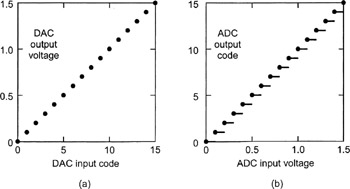
The primary difference between DAC and ADC testing relates to the fundamental difference in their transfer curves. As discussed in Chapter 11, the DAC transfer curve is a one-to-one mapping function, while the ADC transfer curve is a many-to-one mapping function (Figure 12.1). In this chapter, we will see that the ADC curve in Figure 12.1 is actually an idealized one. The output codes generated by a real-world ADC are affected by noise from the input circuits. As a result, an ADC curve is statistical in nature rather than deterministic. In other words, for a given input voltage, it may not be possible to predict exactly what output code will be produced. Before we can study testing methods for ADCs, we should first examine the statistical nature of a true ADC transfer curve.
To understand the statistical nature of ADCs, we have to model the ADC as a combination of a perfect ADC and a noise source...