Introduction to Plastics Recycling, Second edition
Chapter 2: Back to Basics

To recycle a plastic it is necessary to have an understanding of both what the material is, and how it is likely to behave. Plastics are made up of polymers and other materials that are added to give the polymer increased functionality. Some of these materials will be introduced later in the chapter, but first a brief introduction to polymers is required.

2.1 Polymers

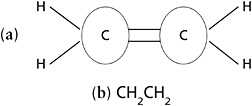
Polymers take their name from two Greek words: poli which means many and meros which means parts. This is because they are made up of a number of repeat units, called monomers. The simplest and most commonly used monomer is ethylene. Chemically it consists of two carbon atoms (C) and four hydrogen atoms (H). It can be represented in the two ways shown in Figure 2.1. The lines shown in Figure 2.1(a) represent the bonds that exist between the atoms to form a molecule.


Figure 2.1: An ethylene molecule

It is the existence of the double bond between the carbon atoms in ethylene, which allows the creation of the many-ethylene, or, to use the proper term, polyethylene. This happens when the monomers are combined by a process called polymerisation to form a chain such as the one shown in Figure 2.2. A chain of useful polymer may consist of 200-2,000 of the monomers joined together. This particular type of polymerisation is called addition polymerisation. The ethylene monomer is termed an unsaturated monomer. The term unsaturated applies to the double bond that exists between the carbon atoms.

UNLIMITED FREE
ACCESS
TO THE WORLD'S BEST IDEAS

SUBMIT
Already a GlobalSpec user? Log in.

This is embarrasing...

An error occurred while processing the form. Please try again in a few minutes.

Customize Your GlobalSpec Experience

Category: Polymers and Plastic Resins
Finish!
Privacy Policy

This is embarrasing...

An error occurred while processing the form. Please try again in a few minutes.