Introduction to Plastics Recycling, Second edition
The plastic material suppliers often carry out compounding. They will receive a quantity of virgin base polymer, such as polypropylene, from a polymer manufacturer and create a number of different formulations and grades for sales to their customers, who will require materials that can meet the specific needs of their end use applications. For example, simply by adding pigments, they can create a range of colours. In some cases this process might be continuous: instead of pelletising, the result may be an extruded product such as pipe.
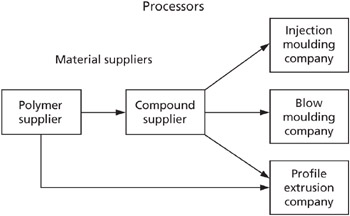
In considering the thermal history of plastics, most material will already have passed through some kind of a processing cycle before it even goes to the final manufacturer to make saleable production components. Examples of possible supply chains are shown in Figure 6.5.
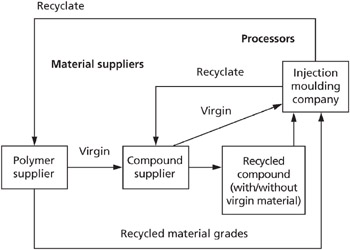
When considering recycling of these materials, a similar supply chain may operate. Recyclate materials may be utilised by either the polymer supplier or the compound supplier to produce grades containing all recyclate, a mixture of recyclate and additives, or a mixture of recyclate and virgin material. Additives for recyclates will be discussed in greater detail in Chapter 7. A possible supply chain for recyclates is shown in Figure 6.6.
Processors may also perform compounding themselves, to customise materials for their own specific requirements. This may include the addition of colourants, regrind materials...