Introduction to Plastics Recycling, Second edition

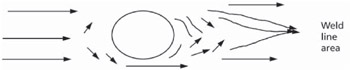
Whenever molten flows come together a weld line will be produced. Weld lines are common to almost all processing operations as often on passing through extruders or moulds (extruder dies, injection moulding tools, blow moulding tools), molten flows will meet obstructions which split material into different streams, this is shown in Figure 6.15. How well the materials can knit back together, will affect the weld line strength.
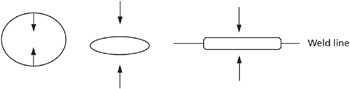
In extrusion blow moulding of bottles, for the bottle to be sealed the parison must weld at the seam. The parison is pressed together by the blow moulding tool, creating a weld line as shown in Figure 6.16.
The strength at the weld will depend on how well the material can knit across the interface. In Figure 6.17, two possible outcomes are shown. On the right, polymer chains (indicated in bold), are able to cross over the interface forming a bond between both sides of the blown parison. To do this the polymer needs to be in the molten state: if the material solidifies, chains cannot pass from one side of the interface to the other. The left-hand diagram shows no chain entanglements at the interface and therefore there is no bond between these two plastic sections. The number of entanglements will be related to the weld line strength, the more entanglements there are the higher the strength...