An Introduction to Statistical Signal Processing
3.5: Distributions of Random Vectors

3.5 Distributions of Random Vectors

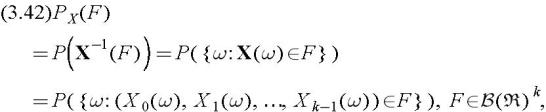
Since a random vector takes values in a space k, one might expect that the events in this space, that is, the members of the event space ( ) k, should inherit a probability measure from the original probability space. This is in fact true as one would expect by analogy to scalar random variables. Also analogous to the case of a random variable, the probability measure is called a distribution and is defined as


where the various forms are equivalent and all stand for Pr( X ? F). Equation (3.42) is the vector generalization of the inverse image equation (3.22) for random variables. Hence (3.42) is the fundamental formula for deriving vector distributions, that is, probability distributions describing random vector events. Keep in mind that the random vectors might be composed of a collection of samples from a random process.

By definition the distribution given by (3.22) is valid for each component random variable. This does not immediately imply, however, that the distribution given by (3.42) for events on all components together is valid. As in the case of a random variable, the distribution will be valid if the output events F ? ( ) k have inverse images under X that are input events, that is, if X ?1( F) ? for every F ? ( ) k. The following subsection treats this subtle issue in further detail, but the only crucial point...

UNLIMITED FREE
ACCESS
TO THE WORLD'S BEST IDEAS

SUBMIT
Already a GlobalSpec user? Log in.

This is embarrasing...

An error occurred while processing the form. Please try again in a few minutes.

Customize Your GlobalSpec Experience

Category: Learning Management Systems (LMS)
Finish!
Privacy Policy

This is embarrasing...

An error occurred while processing the form. Please try again in a few minutes.