An Introduction to Statistical Signal Processing
3.9: Additive Noise

3.9 Additive Noise

The next examples of the use of conditional distributions treat the distributions arising when one random variable (thought of as a noise term) is added to another, independent random variable (thought of as a signal term). This is an important example of a derived distribution problem that yields an interesting conditional probability. The problem also suggests a valuable new tool which will provide a simpler way of solving many similar derived distributions the characteristic function of random variables.

Discrete additive noise

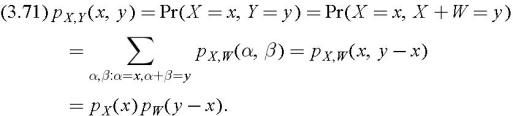
Consider two independent random variables X and W and form a new random variable Y = X + W. This could be a description of how errors are actually caused in a noisy communication channel connecting a binary information source to a user. In order to apply the detection and classification signal processing methods, we must first compute the appropriate conditional probabilities of the output Y given the input X. To do this we begin by computing the joint pmf of X and Y using the inverse image formula:


Note that this formula only makes sense if y ? x is one of the values in the range space of W. Thus from the definition of conditional pmf s,


an answer that should be intuitive: given the input is x, the output will equal a certain value y if and only if the noise exactly makes up the difference, i.e., W =

UNLIMITED FREE
ACCESS
TO THE WORLD'S BEST IDEAS

SUBMIT
Already a GlobalSpec user? Log in.

This is embarrasing...

An error occurred while processing the form. Please try again in a few minutes.

Customize Your GlobalSpec Experience

Category: Noise Figure Meters
Finish!
Privacy Policy

This is embarrasing...

An error occurred while processing the form. Please try again in a few minutes.