An Introduction to Statistical Signal Processing
The derivation of the MAP detector or classifier extends immediately to the situation of a binary input random variable and independent Gaussian noise just treated. As in the purely discrete case, the MAP detector
( y) of X given Y = y is given by
Since the denominator of the conditional pmf does not depend on x (only on y), given y the denominator has no effect on the maximization
Assume for simplicity that X is equally likely to be 0 or 1 so that the rule becomes
The constant in front of the pdf does not affect the maximization. In addition, the exponential is a mononotically decreasing function of x ? y, so that the exponential is maximized by minimizing this magnitude difference, i.e.,
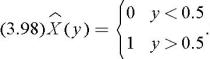
which yields a final simple rule: see if x = 0 or 1 is closer to y as the best guess of x. This choice yields the MAP detection and hence the minimum probability of error. In our example this yields the rule
Because the optimal detector chooses the x that minimizes the Euclidean distance x ? y to the observation y, it is called a minimum distance detector or rule. Because the guess can be computed by comparing the observation to a threshold (the value midway between the two possible values of x), the detector is also called...