An Introduction to Statistical Signal Processing
Appendix B: Sums and Integrals

In this appendix a few useful definitions and results are gathered for reference.

B.1 Summation

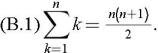
The sum of consecutive integers


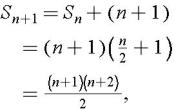
Proof The result is easily proved by induction, which requires demonstrating the truth of the formula for n = 1 (which is obvious) and showing that if the formula is true for any positive integer n, then it must also be true for n + 1. This follows since if and we assume that S n = n( n + 1)/2, then necessarily


proving the claim.

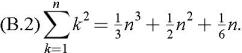
The sum of consecutive squares of integers


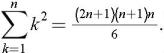
The sum can also be expressed as


Proof This can also be proved by induction, but for practice we note another approach. Just as in solving differential or difference equations, one can guess a general form of solution and solve for unknowns. Since summing k up to n had a second-order solution in n, one might suspect that solving for a sum up to n of squares of k would have a third-order solution in n, that is, a solution of the form f( n) = an 3 + bn 2 + cn + d for some real numbers a, b, c, d. Assume for the moment that this is the case, then if f( n) = , clearly n 2 = f( n)

UNLIMITED FREE
ACCESS
TO THE WORLD'S BEST IDEAS

SUBMIT
Already a GlobalSpec user? Log in.

This is embarrasing...

An error occurred while processing the form. Please try again in a few minutes.

Customize Your GlobalSpec Experience

Category: Inorganic Chemicals and Compounds
Finish!
Privacy Policy

This is embarrasing...

An error occurred while processing the form. Please try again in a few minutes.