An Introduction to Statistical Signal Processing
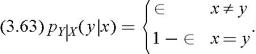
Consider a simple, but nonetheless very important, example of the application of conditional probability mass functions describing discrete random vectors. Suppose that X is a binary random variable described by a pmf p X, with p X(1) = p. It might be one bit in some data coming through a modem. You receive a random variable Y, which is equal to X with probability 1 ? ?. In terms of a conditional pmf this is
This can be written in a simple form using the idea of modulo 2 (or mod 2) arithmetic which will often be useful when dealing with binary variables. Modulo 2 arithmetic or the Galois field of 2 elements arithmetic consists of an operation ? called modulo 2 addition defined on the binary alphabet {0, 1} as follows:
The operation ? corresponds to an exclusive or in logic; that is, it produces a 1 if one or the other but not both of its arguments is 1. An equivalent definition for the conditional pmf is
For example, the channel over which the bit is being sent is noisy in that the receiver occasionally makes an error. Suppose that it is known that the probability of such an error is ?. The error might be very small on a good phone line, but it might be very large if an evil hacker is trying to corrupt your data. Given...