Iterative Receiver Design

Exploiting the power of factor graphs, this detailed text provides a general framework for systematically developing iterative algorithms for digital receivers, and highlights connections between important algorithms.
 TABLE OF CONTENTS
 Apart from decoding and demapping, a factor-graph-based receiver also requires an equalizer. The equalizer performs the SPA on the equalization node p( Y = y A,  ), seen in Fig. 10.1, where a is the sequence of unknown coded data symbols and y is the known observation. The observation is obtained by suitable processing of the received waveform. This processing depends highly on the specific communication scenario (number of users, number of antennas, etc.) and will be dealt with in Chapters 11 13. Here we work in a more abstract setting. This chapter builds on the works [96 100].
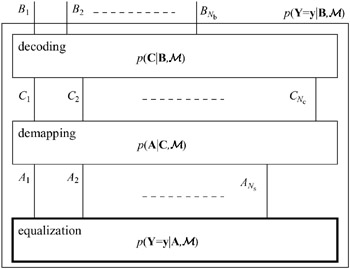 ). The node is opened to reveal its structure. The node in bold is the topic of this chapter.
The observation y is generally a non-deterministic function of the data symbols a. As we have seen in Chapter 2, the signal at the receiver is corrupted by noise, has been passed through a physical channel, and may depend on symbols other than the N s data symbols we are interested in. This gives rise to the following very general relation between the observation y and the coded symbols a:

where n is a complex Gaussian noise vector, represents symbols that affect the observation y but are not part of a and h( ) is the transformation encapsulating the physical channels as well as any processing at the...