Iterative Receiver Design

Exploiting the power of factor graphs, this detailed text provides a general framework for systematically developing iterative algorithms for digital receivers, and highlights connections between important algorithms.
 TABLE OF CONTENTS
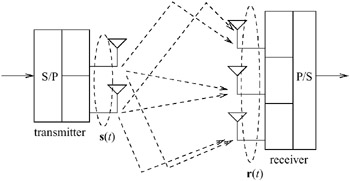
 From Chapter 2 we know that in multi-antenna (or MIMO) communication the transmitter and/or the receiver are equipped with multiple antennas (see Fig. 12.1). Multiple receive antennas allow the reception of multiple independent copies of the transmitted signal, translating into more reliable communications through diversity: when one receive antenna is in a deep fade, another antenna may experience a better channel. Multiple transmit antennas can be used either to increase throughput (since independent data streams can be transmitted on the different antennas) or to ensure more reliable communication (through diversity). The receiver has the task of combining the information on its antennas and of possibly separating the signals coming from different transmit antennas. In this chapter, we will apply the factor-graph framework and derive receivers for single- and multi-carrier modulation. In particular, receivers for space time coding, spatial multiplexing, and MIMO-OFDM will be detailed.
This chapter is organized as follows.
In Section 12.2 we focus on single-carrier modulation and describe how a suitable observation y can be obtained, and how messages from the equalizer node to the demapper node can be computed. Both spatial multiplexing...