Iterative Receiver Design

Exploiting the power of factor graphs, this detailed text provides a general framework for systematically developing iterative algorithms for digital receivers, and highlights connections between important algorithms.
 TABLE OF CONTENTS
 In multi-user communications, users transmit signals to a single receiver over the same channel (see Fig. 13.1). For the receiver to recover the information from the various users successfully, the channel must be shared between the users.
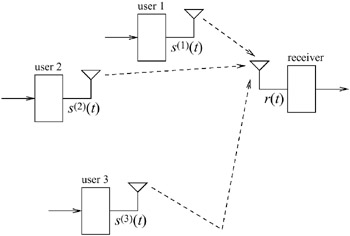
Multiple-access techniques such as time-division multiple access (TDMA) and frequency-division multiple access (FDMA) make users completely orthogonal to each other, resulting in simple receivers, but at the same time giving rise to significant losses in terms of bandwidth efficiency. To overcome this, techniques such as direct-sequence code-division multiple access (DS-CDMA) were developed, whereby all users transmit simultaneously over the same frequency band. A conventional DS-CDMA receiver would consist of a bank of single-user detectors (so-called Rake receivers [115]), one for each user. Multiple-access interference (MAI) is ignored at the output of the Rake receiver.
Thanks to the pioneering work of Verd [31], it has become clear that detecting the information from the various users jointly can lead to significant performance gains. This is known as multi-user detection (MUD). Since optimal MUD is usually intractable, iterative MUD has received a great deal of attention from the research community [97, 116]. The standard reference work on iterative MUD is by...