Kanban Made Simple: Demystifying and Applying Toyota's Legendary Manufacturing Process

Using Toyota as an example, this is a step-by-step guide to incorporating the ingenuity of the kanban system into any manufacturing environment.
 TABLE OF CONTENTS
 Many people think they only need to figure out the size of the kanban and they are ready to start up their kanban. Unfortunately, once they calculate the kanban size they are only partially ready. To successfully implement a kanban requires not only setting container quantities, but also the development of a design, deployment of the design, and training of the design. This chapter and the next two chapters will address these three topics. Thus our process flow expands, as shown in Figure 5-1, to include designing the kanban.
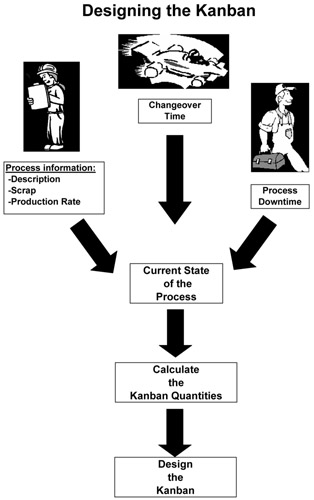
When we think of kanban design we should think about three things:
Selecting the signaling mechanism for the kanban
Developing the rules for operation of the kanban
Creating the visual management plans for the kanban
These three items will ensure that you have a design that can be successfully implemented. Consider each activity as an integral step on the road to successful implementation.
Setting up the scheduling signal means to develop a signal that tells the production operators when to:
Produce parts
Change over
Stop production
This signal replaces the traditional production schedule. The signal can be cards, buggies, objects on a fixed board, etc. The only requirements for selecting a signal are that it must be unambiguous, readily understood, and maintainable.
The rules you develop for the kanban will drive its operation. They will be the guidance that allows the operators to control the production...