Kanban Made Simple: Demystifying and Applying Toyota's Legendary Manufacturing Process

Using Toyota as an example, this is a step-by-step guide to incorporating the ingenuity of the kanban system into any manufacturing environment.
 TABLE OF CONTENTS
Implementing kanban in a large plant can seem like a daunting task. On the surface, it would seem to be extremely difficult to maintain all of the visual signals that would be required to control production in a large plant. In reality, this is not the case. A large plant will be run by a series of small kanbans, all of which are simple to operate. In fact, implementation is the most difficult task in operating a large plant with kanbans, since there are so many different kanbans that need to be installed and so many employees to train. Once the kanbans are implemented, it is simply a matter of auditing the kanbans, keeping people trained, and continuously improving the kanbans.
Figure F-1 demonstrates how these independent kanban loops are linked to control product flow through the entire plant. There are three basic kinds of loops: Finished Goods, WIP, and Raw Materials.
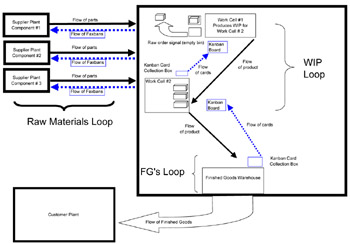
The finished goods loops control the amount of finished goods (product ready to be shipped to the customer) that you carry. This loop is extremely important, as it protects your customer from disruptions within your process. Having finished goods inventory also allows you to respond quickly to unexpected increases in customer demand. And although disruptions within your plant can cost you money (high scrap or productivity losses), disruptions in shipments to your customer can cost you sales.
The WIP loops control the plant's WIP inventory. As you continuously improve the kanban...