Kanban Made Simple: Demystifying and Applying Toyota's Legendary Manufacturing Process

Using Toyota as an example, this is a step-by-step guide to incorporating the ingenuity of the kanban system into any manufacturing environment.
 TABLE OF CONTENTS
 Throughout the book we have developed a basic model (repeated in Figure 10-1) for the implementation of kanban scheduling. This model contains seven steps, listed in Figure 10-2, for implementing and maintaining the kanban. In keeping with the basic tenets of the Toyota Production System and Lean manufacturing, we have shown this model as a continuous loop of implementing and improving the kanbans. Today's competitive manufacturing environment requires this philosophy of continuous improvement and change to survive.
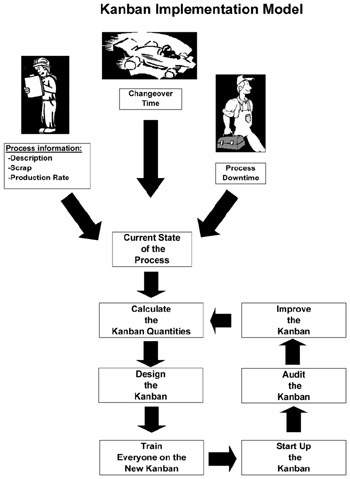
Conduct data collection
Calculate the kanban size
Design the kanban
Train everyone
Start the kanban
Audit and maintain the kanban
Improve the kanban
In Chapter 1, we also said that many people didn't implement kanban because of lack of understanding and fear of change. We hope that this book clears up the lack of understanding and that it gives you the means to address your implementation fears. We believe that the best way to address your fears is by developing plans that prevent these fears from occurring. This belief leads us to stress:
Using current process data to calculate the kanban quantities
Developing written kanban operating rules and visual management plans that spell out the when, where, and who of the kanban design
We also proposed several keys to successful implementation of kanban scheduling to help in formulating your kanban. These items are shown in Figure 10-3. Throughout the book we have built our concepts around these keys.
Size the kanban...