Kanban Made Simple: Demystifying and Applying Toyota's Legendary Manufacturing Process

Using Toyota as an example, this is a step-by-step guide to incorporating the ingenuity of the kanban system into any manufacturing environment.
 TABLE OF CONTENTS
Once the kanban has started, the next task becomes keeping it going and reducing the kanban quantities. The task of keeping the kanban going centers on the process of auditing and making corrections as problems are discovered. This chapter addresses the auditing function and proposes a process for implementing corrective action. Chapter 9 will address how to reduce the kanban quantities by implementing the continuous improvement techniques of Single Minute Exchange of Dies (SMED), Total Productive Maintenance (TPM), Preventative Maintenance (PM), 5s, scrap reduction, and buffer reduction. Our kanban process flow now expands to include auditing of the kanban, as shown in Figure 8-1.
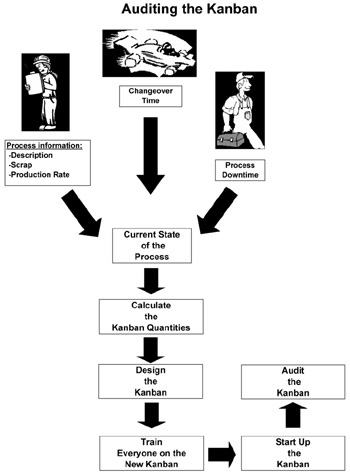
By auditing of the kanban we mean verifying the kanban runs as designed. The plant material managers or schedulers usually perform this task.
The audit process consists of cycle counting and reviewing past production records. The cycle count will provide an up-to-the-minute inventory that can be compared to the signals to make sure they match. The review of production records will confirm that the production operators are following the kanban signals. When auditors find a problem, they must implement the necessary changes or seek help to get the kanban back on track. When the correction is not obvious, problem solving will be required to identify and correct the problem.
The auditing function also includes making sure the kanban size is adequate to support any production requirement changes. To determine whether the kanban size supports production requirements, compare the current...