The Master Handbook of Acoustics, Fourth Edition

The law of the conservation of energy states that energy can neither be created nor destroyed, but it can be changed from one form to another. If we have some sound energy in a room to get rid of, how can it be done? Sound is the vibratory energy of air particles, and it can be dissipated in the form of heat. If it takes the sound energy of a million people talking to brew a cup of tea, we must give up any idea of heating our home with sound from the high-fidelity loud speakers.
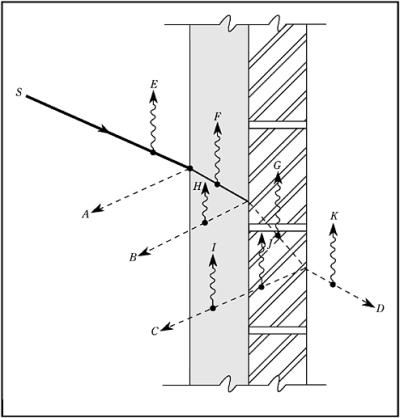
When sound wave S hits a wall (such as in Fig. 9-1), what happens to the energy it contains? If the sound wave is traveling in air and it strikes a concrete block wall covered with an acoustical material, there is first a reflected component A returned to the air from the surface of the acoustical material. Of course, there is a certain heat loss E in the air that is appreciable only at the higher audio frequencies.
Some of the sound penetrates the acoustical material represented by the shaded layer in Fig. 9-1. The direction of travel of...