The Master Handbook of Acoustics, Fourth Edition

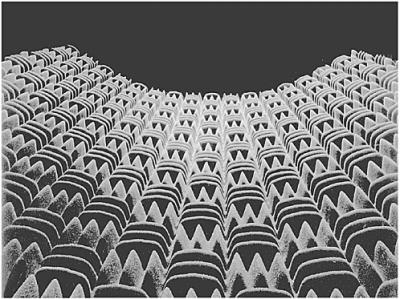
Flexible polyurethane foams are widely used in noise quieting of automobiles, machinery, aircraft, and in various industrial applications. After a slow start, foams are finding some application as sound absorbers in architectural applications, including recording studios and home listening rooms. Figure 9-11 is a photograph of one form of Sonex,4 a foam product contoured to simulate the wedges used in anechoic rooms. These are shaped in male and female molds and come in meshed pairs. This material can be cemented or stapled to the surface to be treated.
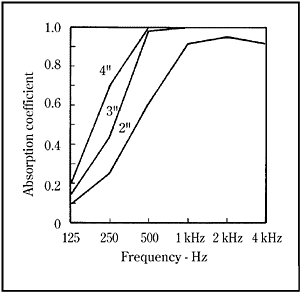
The sound absorption coefficients Sonex for thicknesses of 2 ?, 3 ?, and 4 ? are shown in Fig. 9-12 for Mounting A. The 2 ? glass fiber of Fig. 9-8 is considerably superior acoustically to the 2 ? Sonex but a few things should be considered in this com parison. These are:
The Type 703 has a density of 3 lb/cu ft while Sonex is 2 lb/cu ft.
The 2 ? Sonex is the wedge height and the average thickness is far less, while the 703 thickness prevails throughout.
Comparing the two products is, in a sense, specious because the much higher cost of Sonex is justified in the minds of many by appearance and ease of mounting rather than straight acoustical considerations.