The Master Handbook of Acoustics, Fourth Edition

Chapter 10: Reflection of Sound

If a sound is activated in a room, sound travels radially in all directions. As the sound waves encounter obstacles or surfaces, such as walls, their direction of travel is changed, i.e., they are reflected.

Reflections from Flat Surfaces

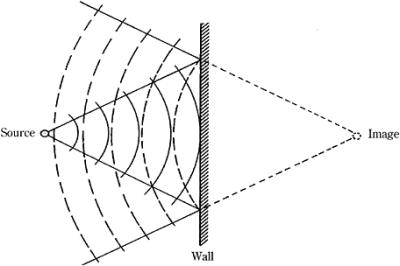
Figure 10-1 illustrates the reflection of waves from a sound source from a rigid, plane wall surface. The spherical wavefronts (solid lines) strike the wall and the reflected wavefronts (broken lines) are returned toward the source.


Figure 10.1: Reflection of sound from a point source from a flat surface (incident sound, solid lines; reflected sound, broken lines). The reflected sound appears to be from a virtual image source.

Like the light/mirror analogy, the reflected wavefronts act as though they originated from a sound image. This image source is located the same distance behind the wall as the real source is in front of the wall. This is the simple case a single reflecting surface. In a rectangular room, there are six surfaces and the source has an image in all six sending energy back to the receiver. In addition to this, images of the images exist, and so on, resulting in a more complex situation. However, in computing the total sound intensity at a given receiving point, the contributions of all these images must be taken into consideration.

Sound is reflected from objects that are large compared to the wavelength of the impinging sound. This book would be a good reflector for 10 kHz sound (wavelength about an inch).

UNLIMITED FREE
ACCESS
TO THE WORLD'S BEST IDEAS

SUBMIT
Already a GlobalSpec user? Log in.

This is embarrasing...

An error occurred while processing the form. Please try again in a few minutes.

Customize Your GlobalSpec Experience

Category: Audio Transducers and Buzzers
Finish!
Privacy Policy

This is embarrasing...

An error occurred while processing the form. Please try again in a few minutes.