Mathematica Demystified

Simple enough for a beginner, but challenging enough for an advanced user, this hands-on guide takes you from your very first calculation all the way to plotting complex fractals in Mathematica.
 TABLE OF CONTENTS
 One of the practical applications of calculus is to find maxima and minima. For example, suppose we want to find the shape of a cylindrical can that contains the most volume for a given amount of surface area. Suppose the can has a circular base of radius r and a height of h. Then its volume is V = ?r 2h (area of the base times the height) while its surface area is S = 2 ?r 2 + 2 ?rh (twice the area of the base plus the area of the sides, which is the circumference times the height). Keeping S fixed we want to vary r and h so as to obtain the largest volume. The volume is ostensibly a function of two variables, but because the surface area must remain constant the two variables are not independent. In fact, we can solve for one in terms of the other and the surface area S. It is easiest to solve for h in terms of r and S obtaining 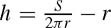 . If we now substitute this into the formula for the volume we obtain
  . This is a cubic function of r and we have plotted its graph in Example 7.5.1. Note that we have let S = 1 in the plot, which makes sense because we may as well assume there is "one unit" of...