10.2 The Binomial (Bernoulli) Distribution
The Binomial (Bernoulli) distribution is defined as
for k = 0, 1, 2, , n and 0 < p < 1. Therefore, b(k;n;p) is non-negative.
From (10.12) and (10.11),
and thus the binomial distribution b(k;n;p) is a pdf of the discrete type.
In (10.13), we call p the probability of a success. Likewise, we call q the probability of a failure.
Then,
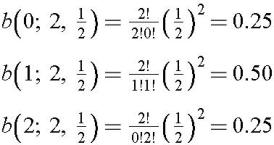
For n = 2 and p = 1/2, (10.12) becomes
Moreover, for k = 0, 1 and 2, (10.15) reduces respectively to
The pdf and cdf of the binomial distribution for n = 2, p = 1/2, and k = 0, 1, and 2 are shown in Figures 10.1 and 10.2, We observe that they are the same as in Example 9.1, Chapter 9, Page 9 7,
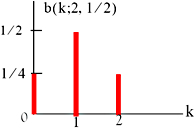 Figure 10.1: Probability density function for the binomial distribution
 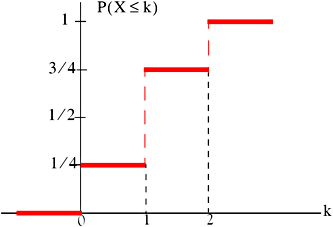 Figure 10.2: Cumulative distribution function for the binomial distribution.
 Example 10.1 A coin is tossed six times. Compute:
-
the probability that exactly (no more, no less) two heads show up
-
the probability of getting at least four heads
-
the probability of no heads.
-
the probability of at least one head.
Solution:
Here, n = 6. Let us denote p as a success if heads show up, and q as a failure if tails show up. Obviously, q = 1 ? p and p = q = 1/2.
-
We use the binomial distribution with k = 2...


 TABLE OF CONTENTS