Mathematics for Business, Science, and Technology with MATLAB and Excel Computations, Third Edition
This appendix discusses a method that we can use to predict the probability that a company will go bankrupt. It was introduced by Edward Altman, a financial economist at New York University s Graduate School of Business, and it is now known as The Altman Z-score.
The Altman Z-score [*] combines a set of five financial ratios A, B, C, D, and E defined as
This ratio is a measure of the return, before interest and taxes, that a firm is earning on its investment in assets. Earnings Before Interest and Taxes (EBIT) is equal to Net Income plus Income Taxes and Interest paid.
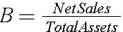
This ratio is a measure of the sales-generating of the corporation s assets.
In this ratio, the Market Value of Equity is used whenever the common stock price is not available. The Book Value of Total Liabilities is the book value of the current debt.
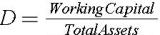
This ratio is a measure of the net liquid assets relative to the total capitalization. Obviously, this ratio will be decreasing for a company with consistent operating losses. The Working Capital is equal to current assets minus current liabilities.
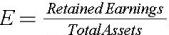
This ratio is a measure of cumulative profitability with respect to total assets. Since new companies, in general, have a greater likelihood of failure, this measure is very critical for new companies.
Once the financial ratios A, B, C, D, and E above are defined, The Altman Z-score is computed as
[*] This Z-score...