Matrix Analysis and Applied Linear Algebra

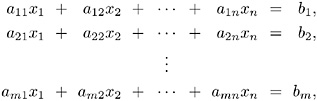
We are now ready to analyze more general linear systems consisting of m linear equations involving n unknowns
where m may be different from n. If we do not know for sure that m and n are the same, then the system is said to be rectangular . The case m = n is still allowed in the discussion statements concerning rectangular systems also are valid for the special case of square systems.
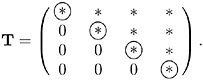
The first goal is to extend the Gaussian elimination technique from square systems to completely general rectangular systems. Recall that for a square system with a unique solution, the pivotal positions are always located along the main diagonal the diagonal line from the upper-left-hand corner to the lower-right-hand corner in the coefficient matrix A so that Gaussian elimination results in a reduction of A to a triangular matrix , such as that illustrated below for the case n = 4:
Remember that a pivot must always be a nonzero number. For square systems possessing a unique solution, it is a fact (proven later) that one can always bring a nonzero number into each pivotal position along the main diagonal. [8] However, in the case of a general rectangular system, it is not always possible to have the pivotal positions lying on a straight diagonal line in the coefficient matrix. This means that the final result of Gaussian elimination...