Matrix Analysis and Applied Linear Algebra

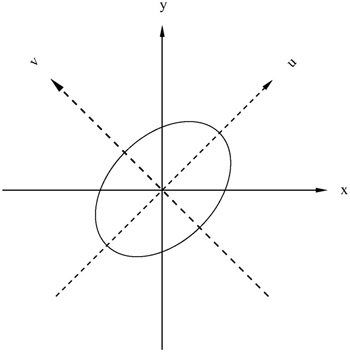
The correct choice of a coordinate system (or basis) often can simplify the form of an equation or the analysis of a particular problem. For example, consider the obliquely oriented ellipse in Figure 7.2.1 whose equation in the xy -coordinate system is
By rotating the xy -coordinate system counterclockwise through an angle of 45 into a uv -coordinate system by means of (5.6.13) on p. 326, the cross-product term is eliminated, and the equation of the ellipse simplifies to become
It's shown in Example 7.6.3 on p. 567 that we can do a similar thing for quadratic equations in R n .
Choosing or changing to the most appropriate coordinate system (or basis) is always desirable, but in linear algebra it is fundamental. For a linear operator L on a finite-dimensional space V, the goal is to find a basis B for V such that the matrix representation of L with respect to B is as simple as possible. Since different matrix representations A and B of L are related by a similarity transformation P ?1 AP = B (recall 4.8), [69] the fundamental problem for linear operators is strictly a matrix issue-i.e., find a nonsingular matrix P such that P ?1 AP is as simple as possible. The concept of similarity was first introduced on p. 255, but in the interest of continuity it is reviewed below.
Two