Matrix Analysis and Applied Linear Algebra

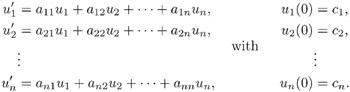
Systems of first-order linear differential equations with constant coefficients were used in 7.1 to motivate the introduction of eigenvalues and eigenvectors, but now we can delve a little deeper. For constants a ij, the goal is to solve the following system for the unknown functions u i( t) .
| (7.4.1) | |
Since the scalar exponential provides the unique solution to a single differential equation u ?( t) = ?u( t) with u(0) = c as u( t) = e ?t c, it's only natural to try to use the matrix exponential in an analogous way to solve a system of differential equations. Begin by writing (7.4.1) in matrix form as u ? = Au, u(0) = c, where
If A is diagonalizable with ?( A) = { ? 1, ? 2,..., ? k}, then (7.3.6) guarantees
| (7.4.2) | |
The following identities are derived from properties of the G i's given on p. 517.
| (7.4.3) | |
| (7.4.4) | |
| (7.4.5) | |
Equation (7.4.3) insures that u = e A t c is one solution to u ? = Au, u(0) = c . To see that u = e A t c is the only solution, suppose v( t) is another solution so that v ? = Av with v(0) = c .