Matrix Analysis and Applied Linear Algebra

A significant portion of linear algebra is in fact geometric in nature because much of the subject grew out of the need to generalize the basic geometry of R 2 and R 3 to nonvisual higher-dimensional spaces. The usual approach is to coordinatize geometric concepts in R 2 and R 3, and then extend statements concerning ordered pairs and triples to ordered n-tuples in R n and C n.
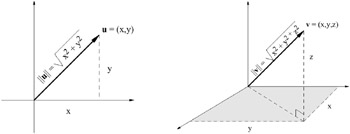
For example, the length of a vector u ? R 2 or v ? R 3 is obtained from the Pythagorean theorem by computing the length of the hypotenuse of a right triangle as shown in Figure 5.1.1.
This measure of length,
is called the euclidean norm in R 2 and R 3, and there is an obvious extension to higher dimensions.
For a vector x n 1, the euclidean norm of x is defined to be
whenever x ? R n 1,
whenever x ? C n 1.
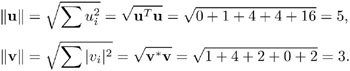
For example, if
and
, then
There are several points to note. [33]
The complex version of x includes the real version as a special case because z 2 = z 2 whenever z is a real number. Recall that if z = a + i b, then z =