Matrix Analysis and Applied Linear Algebra

| 1.2.1 | (1, 0, 0) |
| 1.2.2 | (1, 2, 3) |
| 1.2.3 | (1, 0, -1) |
| 1.2.4 | (-1/2, 1/2, 0, 1) |
| 1.2.5 | |
| 1.2.6 | Every row operation is reversible. In particular the "inverse" of any row operation is again a row operation of the same type. |
| 1.2.7 | ?/2, ?, 0 |
| 1.2.8 | The third equation in the triangularized form is 0 x 3 = 1, which is impossible to solve. |
| 1.2.9 | The third equation in the triangularized form is 0 x 3 = 0, and all numbers are solutions. This means that you can start the back substitution with any value whatsoever and consequently produce infinitely many solutions for the system. |
| 1.2.10 | ? = -3, ? = 11/2, and ? = -3/2 |
| 1.2.11 |
|
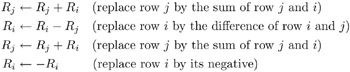
| 1.2.12 | To interchange rows i and j, perform the following sequence of Type II and Type III operations. |
| 1.2.13 | (a) This has the effect of interchanging the order of the unknowns- x j and x k are permuted. (b) The solution to the new system is the same as the solution to the old system except... |